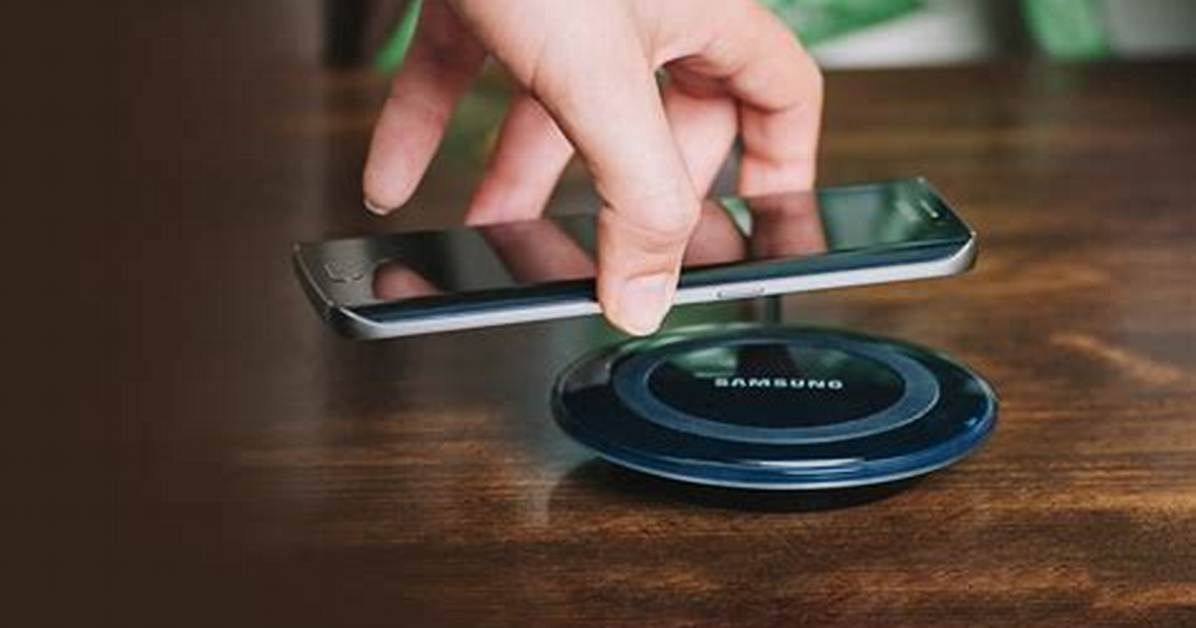
Wireless charging has been around for a long time, but it has taken a while to catch on for phones. There were some definite limitations when it first entered the scene, but problems like the need for precise placement or incredibly slow charging speeds have melted away as the technology has improved.
Samsung was quick to adopt wireless charging in its Galaxy phones, but the technology’s popularity has reached an all time high thanks to its adoption in Apple’s iPhones last year. A potentially tricky standards war also seems to have been won by the Wireless Power Consortium with the wide adoption of the Qi standard.
We’ve been big fans of wireless charging for a few years now. Not having to fumble around with a cable when you want to charge up your phone’s battery is great, especially if it’s dark and you’re trying to avoid waking your partner. But as wireless charging has taken off, a few people have started to ask if there’s a hidden cost. We’ve seen a few articles, forum discussions, and comments suggesting that wireless charging might degrade your battery faster than traditional wired charging. We decided to investigate and find out if there’s any truth to this supposition.
How does a phone battery work?
Our smartphones use lithium-ion batteries. Cells have two electrodes – a cathode and an anode — with an electrolyte in between which allows the lithium ions to move between the electrodes. When you charge they go from positive to negative, and when you discharge they move in the opposite direction.
“Electrical energy is changed into chemical energy during charging and the reverse happens during discharge,” Dr. Daniel Abraham, senior scientist at the Argonne Laboratory, told Digital Trends.
The battery manufacturer decides how much energy can be stored in the cell, and that determines how much energy you have available to use.
“The manufacturer decides the upper cut off voltage and the lower cut off voltage, which are fixed, and cells cycle between the two voltage ranges,” Dr. Abraham explained. “As long as you choose the voltage range appropriately, you can cycle the cell thousands of times.”
“It doesn’t matter if you have a wireless or wired charger.”
It’s not possible to exceed these limits by leaving your phone on the wireless charging pad for too long, or by leaving it plugged in overnight. You also can’t drain the cell beyond the lower cut off limit dictated by the manufacturer. These limits don’t distinguish between power sources.
“It doesn’t matter if you have a wireless or wired charger,” Dr. Abraham said. “You won’t be able to overcharge or over-discharge a cell.”
What about cycle limits?
Different batteries have different standards, but it’s accepted that beyond a certain number of charge cycles, a battery is going to degrade. In the case of Apple’s iPhone devices , for example, batteries are designed to retain up to 80 percent of original capacity after 500 complete charge cycles.
One of the criticisms levelled at wireless charging, as explained in this ZDNet article, is that when phones charge via the cable the battery gets a rest, but when they charge on a wireless charging pad it doesn’t. Therefore, the battery goes through its limited number of cycles faster with wireless charging and degrades faster. But is this true?
“A phone’s battery is not drained when you use it while charging wirelessly,” Menno Treffers, chairman of the Wireless Power Consortium, told Digital Trends. “This is a misunderstanding.”
“A phone’s battery is not drained when you use it while charging wirelessly.”
If you want to slow down charge cycles, the simplest way is to cut the amount of power you use. A rogue app that’s continually sending data in the background, or an area of poor cell connectivity where your phone is trying to boost the signal to connect, are both potentially more damaging to your battery longevity than your charging habits.
As you would expect, the manufacturing process is also important in determining battery longevity.
“The quality of the materials used makes a big difference to how long the battery lasts,” Dr. Abraham explained. “You may end up getting what you pay for.”

